
Key contact

Robin Henry
Partner - Head of Dispute Resolution Services

Dispute Resolution /
Post-M&A disputes and warranty claims are on the rise in today’s fast-paced and complex M&A environment. Parties in a transaction are under pressure to maximise deal value, especially in challenging economic times like a pandemic.

Key contact
Partner - Head of Dispute Resolution Services
Our lawyers have the expertise and experience to provide you with creative, personalised solutions in a clear and understandable way.
Discover a wealth of invaluable guidance in the form of guides and brochures written by our expert lawyers.
Discover the latest insights and thought leadership from our team of legal experts.
Buyers and sellers often find themselves in a dispute over a range of issues, such as:
When M&A and warranty claims arise, it is important to identify the relevant facts, systematically isolate the main commercial issues, and understand the potential economic impact as soon as possible. M&A and warranty claims can involve complex technical and financial issues, as well as cross-border locations, multiple jurisdictions and languages, and different accounting standards. Large sums, usually in the millions, are involved in these types of claims.
Fortunately, many M&A and warranty claims can be resolved through negotiation or mediation, which is often the best solution considering that trust and good-faith communication is essential to the business relationship of the parties post-merger. We support clients through all forms of alternative dispute resolution, which allows the parties to exercise greater control and creativity over the way their dispute is resolved than would be the case in court litigation.
If no settlement can be reached, we look to arbitration or formal litigation to resolve the claim. Most disputes involving warranty claims are typically resolved in arbitration.
+44 20 7470 4429+44 7943 503198robin.henry@collyerbristow.com
Our financial services team has experience in drafting and negotiating master purchase and sale agreements for Islamic finance products, including commodity based Murabaha trades and Sukuk bonds, negotiating with a number of Middle Eastern Banks in the process.
On the disputes side, we have been instructed by a number of state-owned Middle Eastern banks over the years on various financial and commercial dispute matters. As such we are aware and very familiar with the business and other cultural issues involved in acting both for and against clients in the Arab world.
Hague Convention letters of request are an effective and common tool used by US litigants to obtain evidence and documents from potential witnesses in the UK where the witnesses are unwilling to give evidence voluntarily for US proceedings.
Discover our new series of practical know-how guides for those involved in commercial disputes.
Share and asset purchases are the two methods of acquiring a business in the UK.
Do you know their differences? The business of a sole trader or unregistered partnership can only be acquired through an asset purchase as there is no owning entity for the assets which can be acquired, while a share purchase can be used for the acquisition of all or part of the shares in a company which owns and operates a business.
Discover our new series of Corporate Know-How guides.

We look at the flip side of price structuring, instead focusing on how a seller could secure elements of the purchase price that are delayed – or at least obtain comfort around the buyer’s ability to pay them.
Discover our new series of Corporate Know-How guides.

When making an offer for a business, the question of when the consideration will be paid can often be just as important as how much will be paid. We look at four of the most common options available to prospective buyers (beyond upfront cash payments) and the risks/rewards posed by them.
Discover our new series of Corporate Know-How guides.

Often involving complex, cross-border issues, our team has a great deal of experience in resolving the full range of post-M&A disputes.
Authorised push payment (“APP”) fraud is reportedly the largest class of payment fraud in the UK. There may be the opportunity to obtain compensation under a voluntary banking code and to complain to the Financial Services Ombudsman (“FOS”) if compensation is not paid.
Discover our new series of practical know-how guides for those involved in commercial disputes.

Shareholders disputes can arise for any reason, but common circumstances include a divergence of opinion for the future direction of the company or the unfair distribution of responsibilities between the parties.
Discover our new series of practical know-how guides for those involved in commercial disputes.

The purpose of an application to the court to strike out is the deletion of material from a party’s statement of case so that it cannot be relied on in the proceedings. If a whole statement of case is struck out, this should lead to the court giving judgment for the applying party.
Discover our new series of practical know-how guides for those involved in commercial disputes.
Under the Civil Procedure Rules 1998 (“the CPR”), a claimant is expected to take certain steps before issuing court proceedings, including exchanging information with the intended defendant, and attempting to settle the matter in dispute.
Discover our new series of practical know-how guides for those involved in commercial disputes.
Warranties are contractual statements of fact that are typically given by a seller to a buyer in a share purchase agreement (“SPA”) or other contract as one of the ways in which risk is allocated between parties in the acquisition of a target company (the “Target”).
Discover our new series of practical know-how guides for those involved in commercial disputes.

A party to proceedings (usually the defendant) may be able to obtain an order that another party (usually the claimant) provide security for its costs.
Discover our new series of practical know-how guides for those involved in commercial disputes.

Force majeure refers to events which are beyond the control of the parties to a contract such as war, epidemic, geological disaster or an act of god.
Discover our new series of practical know-how guides for those involved in commercial disputes.
Summary judgment is a means by which the court can give judgment on a claim (or a particular issue within a claim) without the need for a trial.
Discover our new series of practical know-how guides for those involved in commercial disputes.

Directors are responsible for the management of a company’s business and so are subject to certain duties to safeguard the interests of the company.
Discover our new series of practical know-how guides for those involved in commercial disputes.

Freezing orders are a severe injunction and are not available by right – the court will exercise its discretion in ordering them.
Discover our new series of practical know-how guides for those involved in commercial disputes.
Disputes in which fraud is suspected involve from the outset important tactical considerations, including identifying, tracing and preserving assets against which to enforce subsequent court orders.
Discover our new series of practical know-how guides for those involved in commercial disputes.
If a breach of contract is so serious that it can be said to go to the core of the contract and deprives the innocent party of the benefit of the contract, then it may be a repudiatory breach that gives the innocent party the option of treating the contract as terminated and seeking damages.
Discover our new series of practical know-how guides for those involved in commercial disputes.
These claims are made under the Insolvency Act 1986 (“the Insolvency Act”) and are known as antecedent transaction claims.
Discover our new series of practical know-how guides for those involved in commercial disputes.
This guide is a very brief outline only of the Court procedure.
Discover our new series of practical know-how guides for those involved in commercial disputes.

The purpose of “disclosure” is to make available to all parties documents which might tend to support or undermine the parties’ cases.
Discover our new series of practical know-how guides for those involved in commercial disputes.

Arbitration is intended to be final and binding but that does not prevent aggrieved parties from applying to the English High Court to challenge the arbitration award.
Discover our new series of practical know-how guides for those involved in commercial disputes.

The various grounds on which a company may be compulsorily wound up are set out in section 122 (1) of the Insolvency Act 1986 (“the Act”).
Discover our new series of practical know-how guides for those involved in commercial disputes.

These requests are governed by Part 18 of the Civil Procedure Rules (“CPR”).
Discover our new series of practical know-how guides for those involved in commercial disputes.
The court can issue an injunction to order a party to refrain from doing a particular action or requiring them to do a specified action.
Discover our new series of practical know-how guides for those involved in commercial disputes.

The courts encourage parties to settle their disputes and “without prejudice” negotiations are a common tool for that.
Discover our new series of practical know-how guides for those involved in commercial disputes.

‘Privilege’ is a key legal concept in litigation.
Discover our new series of practical know-how guides for those involved in commercial disputes.

An overview of our range of commercial litigation services, supporting businesses operating in a vast range of industries in the resolution of a full range of commercial disputes.
Guide to the funding available to claimants for complex commercial litigation (and arbitration). It may be helpful for foreign lawyers who may not have a detailed knowledge of litigation funding or who may operate in a jurisdiction where it is prohibited or unpopular.

An overview of our litigation and arbitration services supporting Counsel instructed by clients on a direct access basis. Our offering is most suited to cases where Counsel is instructed by substantial clients, overseas lawyers or in-house counsel
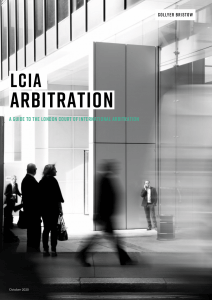
The London Court of International Arbitration (“LCIA”) is one of the world’s leading international institutions for commercial dispute resolution. This guide, prepared mainly to assist non – UK parties, provides an overview of the Court and its processes.

A guide for other law firms on the litigation and arbitration services we provide, and our approach, in circumstances where they require another law firm to act for a client because they have a conflict of interest or for another reason.
M&A Warranty Claims insights
Longer Reads
Read more
Longer Reads
Read more
Podcasts
Listen now
Longer Reads
Read more
Shorter Reads
Read more
Shorter Reads
Read more
Longer Reads
Read more
Podcasts
Listen now
Longer Reads
Read more
Videos
Watch now
News
Read more
Shorter Reads
Read more
You might also like
Need some more information? Make an enquiry below
M&A Warranty Claims key contacts
robin.henry@collyerbristow.comPartner - Head of Dispute Resolution Services
Talk to Robin about Banking & financial disputes, Commercial disputes, Corporate recovery, restructuring & insolvency, Digital, Financial regulatory and Personal insolvency
M&A Warranty Claims
Post-M&A disputes and warranty claims are on the rise in today’s fast-paced and complex M&A environment. Parties in a transaction are under pressure to maximise deal value, especially in challenging economic times like a pandemic.
Key contact
Partner - Head of Dispute Resolution Services
Our lawyers have the expertise and experience to provide you with creative, personalised solutions in a clear and understandable way.
Discover a wealth of invaluable guidance in the form of guides and brochures written by our expert lawyers.
Discover the latest insights and thought leadership from our team of legal experts.
Buyers and sellers often find themselves in a dispute over a range of issues, such as:
When M&A and warranty claims arise, it is important to identify the relevant facts, systematically isolate the main commercial issues, and understand the potential economic impact as soon as possible. M&A and warranty claims can involve complex technical and financial issues, as well as cross-border locations, multiple jurisdictions and languages, and different accounting standards. Large sums, usually in the millions, are involved in these types of claims.
Fortunately, many M&A and warranty claims can be resolved through negotiation or mediation, which is often the best solution considering that trust and good-faith communication is essential to the business relationship of the parties post-merger. We support clients through all forms of alternative dispute resolution, which allows the parties to exercise greater control and creativity over the way their dispute is resolved than would be the case in court litigation.
If no settlement can be reached, we look to arbitration or formal litigation to resolve the claim. Most disputes involving warranty claims are typically resolved in arbitration.
SPOTLIGHT
Our financial services team has experience in drafting and negotiating master purchase and sale agreements for Islamic finance products, including commodity based Murabaha trades and Sukuk bonds, negotiating with a number of Middle Eastern Banks in the process.
On the disputes side, we have been instructed by a number of state-owned Middle Eastern banks over the years on various financial and commercial dispute matters. As such we are aware and very familiar with the business and other cultural issues involved in acting both for and against clients in the Arab world.
M&A Warranty Claims insights
Longer Reads
Read more
Longer Reads
Read more
Podcasts
Listen now
Longer Reads
Read more
Shorter Reads
Read more
Shorter Reads
Read more
Longer Reads
Read more
Podcasts
Listen now
Longer Reads
Read more
Videos
Watch now
News
Read more
Shorter Reads
Read more
Need some more information? Make an enquiry below.
Please note that Collyer Bristow provides this service during office hours for general information and enquiries only and that no legal or other professional advice will be provided over the WhatsApp platform. Please also note that if you choose to use this platform your personal data is likely to be processed outside the UK and EEA, including in the US. Appropriate legal or other professional opinion should be taken before taking or omitting to take any action in respect of any specific problem. Collyer Bristow LLP accepts no liability for any loss or damage which may arise from reliance on information provided. All information will be deleted immediately upon completion of a conversation.
Close
 Business
 Dispute Resolution
Private Wealth
Real Estate
International
Hot Topics
 View profile


